Renewals, the service email, certificates. Nothing sends on its own.
The phone does not stop, so the typing behind it waits. I build software that does the screen work. It drafts. Your licensed person reads the draft and sends it.
I will send you the three screens below, full size, the same day, with nothing to sign up for.
I have never worked a day at an agency desk. I have read your posting line by line, and I know exactly where my software stops.
Whether it works at your office comes down to two things: an export your system can produce, and read access to the service email with no send rights. At a State Farm or Farmers office that is usually a no. I would rather you read that here than find it out on a call.
$1,000 a month. You are billed on day 30, and only if it hits the mark we set together on the call.
Your posting says renewals, endorsements, billing questions, the documents that never came back, and the phone on the first ring.
Reading the message, pulling the policy number and the effective date, writing the reply, noting the file, chasing the client who never came back. That is the part the software does, in your agency’s voice. The part that needs a license stays with the person who has one.
Three piles. Sorted and drafted every morning.
Open the office and the service email is already sorted, with a reply written under each message, and the renewals coming up already written. Nothing has been sent. Every draft is sitting where your person can read it, fix it, or throw it out.
The service email
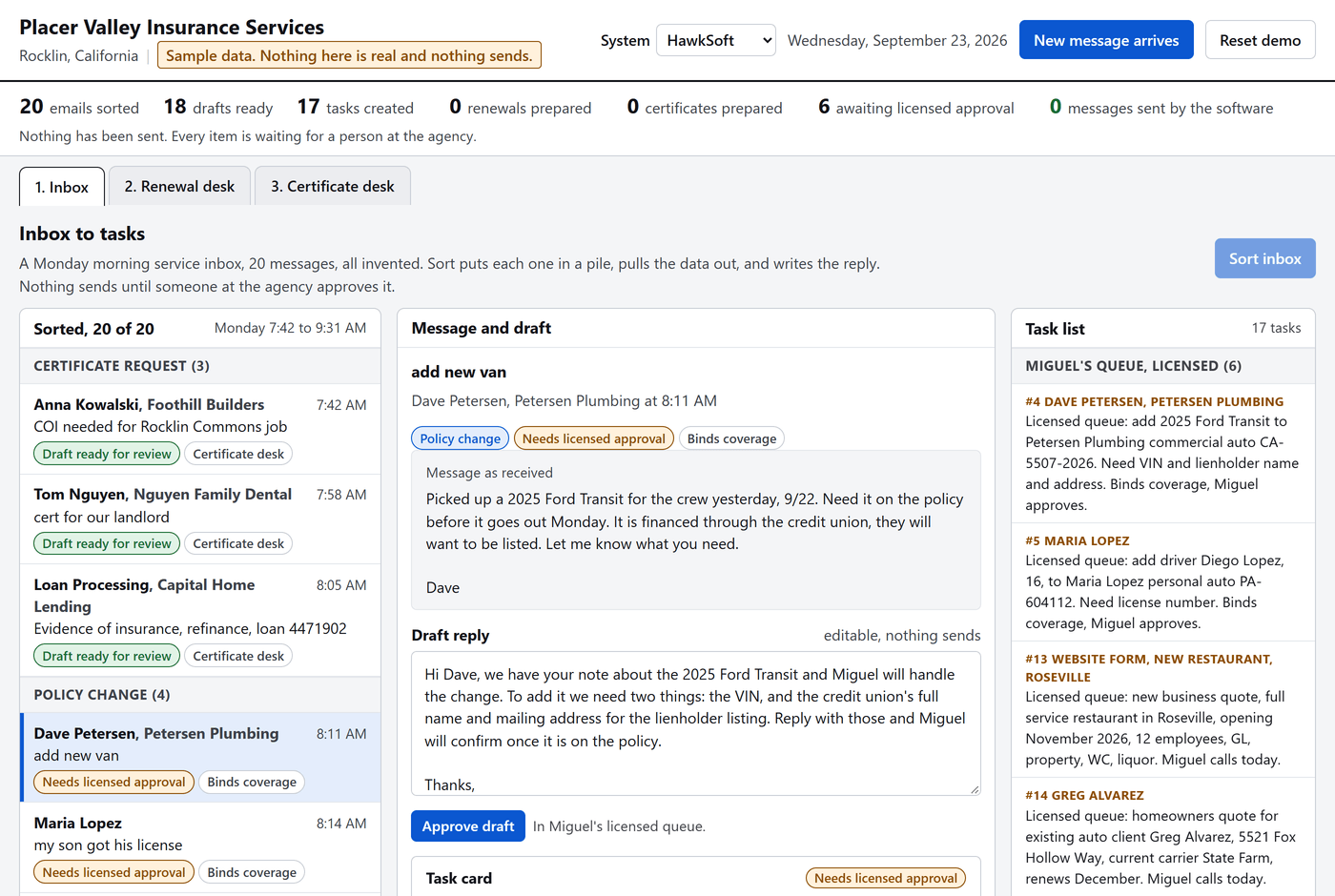
It reads the service email and piles the messages up: a new quote, an endorsement like adding a car or changing the mortgagee, a billing question, a claim to get reported, a request for proof of coverage, other. Under each one it writes the reply and the note for the file, with the policy number and the details already typed in. New quotes go on top, because that is the best email of the day. Anything that binds coverage goes to the person at your agency who is allowed to bind it, for the click.
Renewals
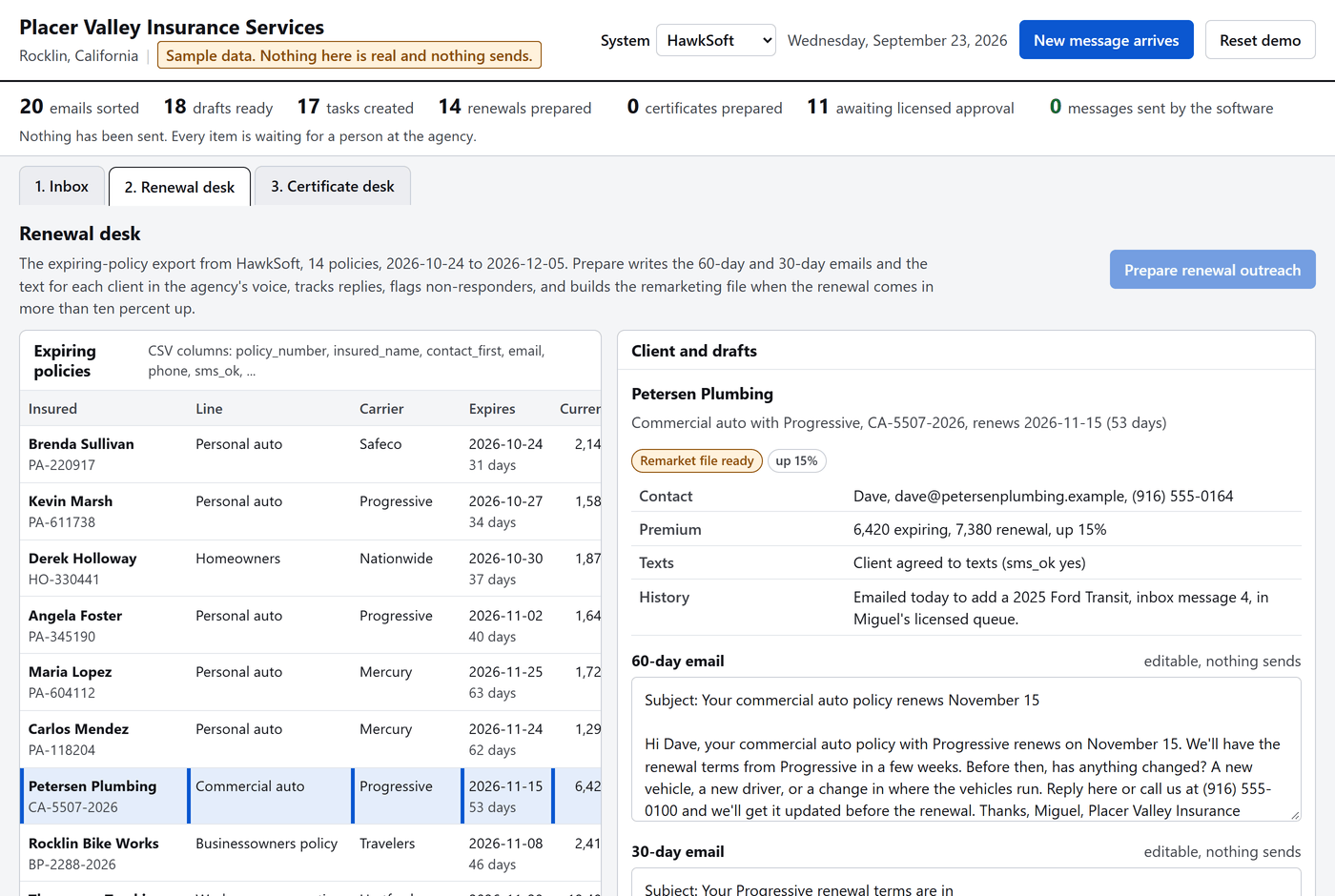
From your expiration list it writes each renewal email on the calendar that policy actually runs on. On personal lines that is the check-in note first, the one that asks whether anything changed, a new car, a new driver, a move, then the note that carries the new premium the day your company posts it. On commercial the file opens early and the loss runs and the signed application get chased by name. When the renewal comes back higher, the draft carries the new number and stops. The line explaining why, and what you would suggest, is left blank on purpose, because that one needs a license.
Certificates and proof of coverage
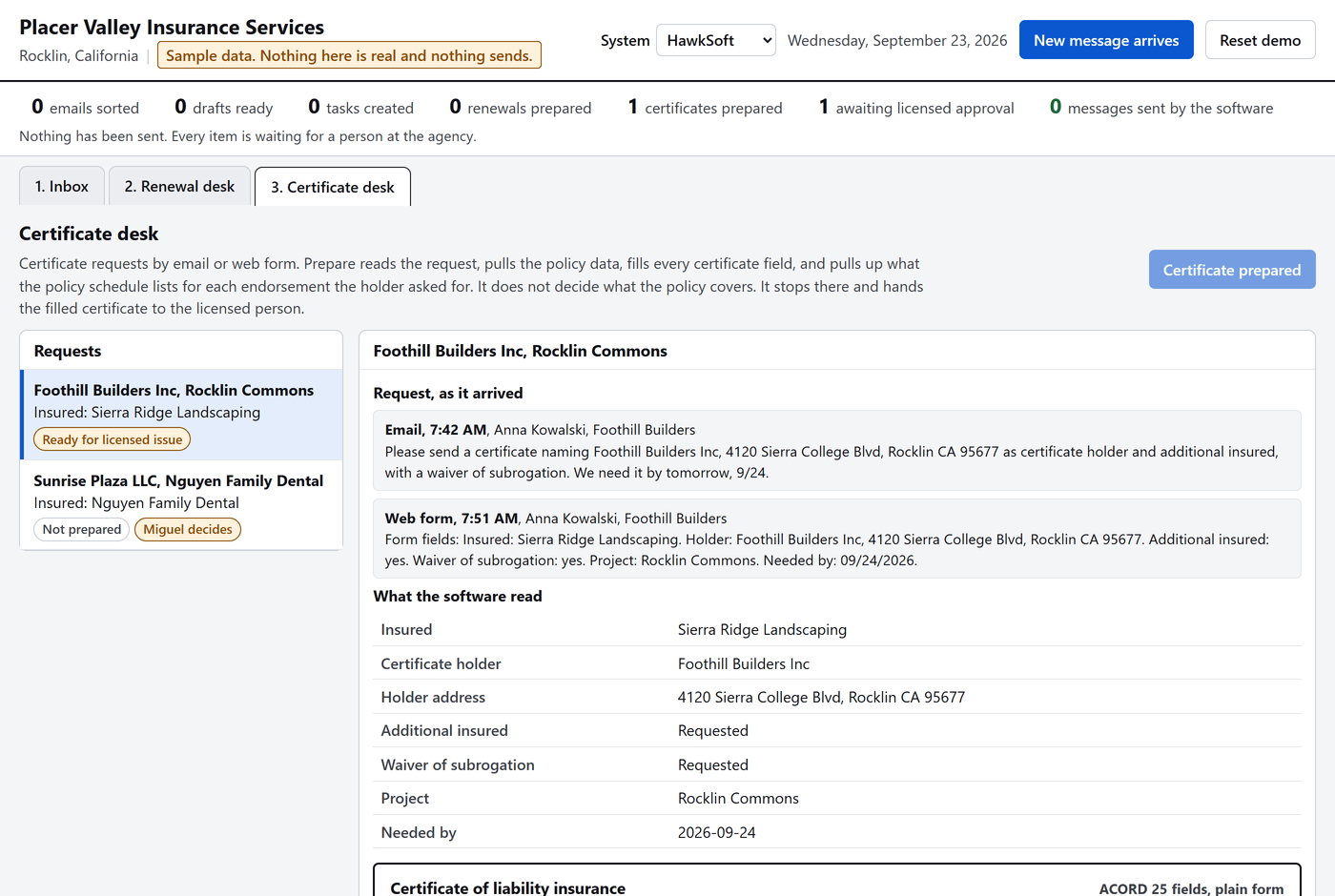
A cert request comes in and it reads what the holder is actually asking for: additional insured, waiver of subrogation, primary and non-contributory, blanket or scheduled. Then it pulls up what the policy schedule lists and puts that in front of your licensed person before anybody checks a box, because the certificate does not add an endorsement that is not there. Your licensed person issues it from your own system, so the issued cert lands on the policy record. On personal lines it is the same job under another name: the lender who wants evidence of insurance before a Thursday closing, or the ID card the leasing office is asking for.
What it does, what it preps, and what it is never allowed to touch.
Before any screen share I read your posting line by line and sort the duties three ways. The line is not mine. California drew it.
Title 10, section 2193.1 of the California regulations says an unlicensed person may prepare binders, certificates, endorsements, identification cards and policies, under a licensee’s supervision and for that licensee’s review and signature, and may never sign them, analyze coverage, give advice, or make a recommendation. That is the sort below. It is not my rule and I cannot move it.
- Green: the software does it. The renewal emails, cert prep, sorting the service email, drafting the replies, writing the note for the file ready to paste, and chasing the signed applications and the documents that never came back.
- Yellow: the software preps, your licensed person reviews and signs. The endorsement is the big one. Somebody writes in to add a car or change the mortgagee, and the software writes up the change they are asking for, with the details pulled from their email, for your licensed person to check against the policy and sign. Same with a binder, a cert, an ID card. Prepared by the software, issued by your person, which is the line above word for word.
- Red: never the software. Coverage advice, recommending a limit, quoting, binding, and signing. Cancellations and reinstatements too, and that last pair is my line and not the state’s, because the day one of those goes out wrong is the day somebody has no coverage. If a client asks whether her nephew can drive her car this weekend, the software does not answer. It drafts a two-line note that your licensed person will call today, and puts the question in their queue.
Nothing sends on its own.
Every draft sits in a queue until someone at your agency clicks approve. It waits where your people open it in the morning, not in your mail. A person sends. It does not answer your phone, it does not greet the person at the counter, and it does not tell a client whether she is covered. It does the typing that piles up behind all three.
The software cannot send, and that is not a promise from me, it is the access you grant. What that access is, exactly, and what I refuse to ask for, is in Your client data below.
It will get things wrong. The design is that it is wrong in front of your person instead of wrong in front of your client. If a draft is wrong twice the same way, tell me and I fix the pattern, not the one email.
This is not the licensed person you are hiring. Hire that person. This is what lets them get through twice the work, or lets you skip a second hire, with their day going to the phone and the coverage instead of the typing.
You keep whatever you run on today, your own agency system or your company’s. It does not type into your system. It writes the note so your person pastes instead of composing. Nothing to install, nothing to move.
The three screens, running on sample data.
This is the whole product. Tap any one to open it full size and read it yourself. Every name, policy number and premium in these is invented.
Thirty days on your own expirations and your own service email.
It runs on your real list and your real email, not on sample data.
You owe nothing for the first thirty days, and nothing at all if it misses the mark.
The mark is one sentence we write down together and both sign before day one. For an office your size it might read, every message in the service email sorted and its reply drafted by five o’clock the same business day. It comes out of your numbers, not mine. Two of the three questions I ask, you should not answer off the top of your head. Ask whoever works the service email. They are the only person who knows, and I will not take a guess as a baseline.
On day 30 you tell me whether it hit. You were the one in the office, so you are the one who calls it, and if you say it missed then it missed. You owe nothing, I turn it off myself, and you get a written account from me saying honestly why.
And if you want out before day 30 for any reason at all, including one you do not feel like explaining, send one email. We stop, and there is no invoice.
What I will not promise
Start here. If any of these is a dealbreaker, we both just saved a call.
- That it replaces anybody, the person you are hiring or the person already sitting there. It does not. Every draft lands in your people’s queue with their name on the approve button.
- That it never gets one wrong. It will, and Where it stops, up the page, says what happens then.
- Hours saved or revenue gained, until we measure where you are today and again on day 30.
- Coverage advice, quoting, binding, or signing. Not from the software, not from me.
- A live connection to a system I have not connected to yet. Version zero reads your expiration list and your service email and touches nothing else. The connection that writes back comes after the pilot.
Terms, in plain English
- Price
- $1,000 a month, the founding rate for the first three agencies. After those three it is $1,500. Three, because three is what I can set up by hand this fall. Your rate holds for as long as you keep the service, and that sentence goes in your agreement.
- Term
- Month to month. Cancel any month with an email and you do not have to explain it. No contract term, no setup fee, and after the first month, billed monthly in advance.
- If you stop
- Nothing of yours is stranded. The expiration list you sent me is a copy of a file you already had, and the notes are in your own system. You can shut my access off from your side without calling me.
- First result
- Three business days after you send the expiration list, every policy on it has a drafted email waiting. Three business days after the mailbox is open, the service email is sorted and drafted every morning. The renewals that came back with an increase go to the top, the new number and the old one side by side, waiting for your licensed person instead of sitting in a pile.
- What it costs your people
- One hour in week one with whoever handles renewals and proof of insurance today, plus the name of whoever is allowed to bind. Not a training session. I want them to show me how your office does it now. After that the only new habit is that somebody reads a draft before it goes, and that is a real part of somebody’s day. I am not going to tell you it is zero.
- Every Friday
- A Friday summary, to you and to whoever works the service email at the same time: what came in, what got drafted, what went out, what got flagged, and what it got wrong that week. Your licensed person gets their own list, and billing gets the billing follow ups already written. It does not count anybody’s clicks.
What I need to start, in this order
- A signed one page agreement, before I see any of it. It says what I may see, what I may never do with your clients’ information, and what happens to it when we stop. Your file is supposed to have that page in it for any vendor who touches client information, and I would rather hand it to you than have you write it.
- Your expiration list for the next ninety days, which most systems will put in a spreadsheet in a couple of clicks. Read it yourself first, because that is exactly what I will see. Ninety days, so the sixty day emails are written before the policy gets there. I will not ask you for a login to your system, and you should not give one to any vendor.
- Ten emails your office has already sent to clients, with the names blacked out. That is what makes the drafts sound like your office and not like me.
- Read and draft access to the service email, with no rights to send, and only after you have seen the drafts. The exact permission, and the two I refuse to ask for, are in Your client data below.
That is the whole list. The terms behind each one are in the pack I send after the call, and I bring my security program, a W-9, and the certificate for the technology errors and omissions policy I will have in place before day one.
These terms were last changed on 20 September 2026. If you are reading this later and something has moved, the version on this page is the one I will honor.

Suraj Swaminathan, Roseville.
An insurance broker paid me to take the messages coming into his service email and turn them into tasks. This product is that job, built out so it runs every morning. His name is not on this page because I have not asked him whether I can put it here. Ask me on the call and I will ask him. If he says yes, you can call him yourself.
Before that I built an AI tutor that a college economics professor set up for his course this fall. I am telling you that so you know I ship things, not because it has anything to do with your agency.
I am not a licensed agent. There is no license number on this page because I do not have one, and that is the point. Anything that quotes, binds, or advises on coverage goes to the licensed person at your agency. That includes me on the phone, even when the answer looks obvious to me, and it does not change when I get bigger.
No agency runs this yet. You would be the first, the second, or the third, and you should hear that from me instead of finding it out. I am one person and I am 22, and both of those are on this page so neither one is a surprise on the screen share. You get a setup built by hand around the way your office already works. The cost is that I cannot be in two places at once, which is why I am taking three agencies this fall and not thirty. If the software misses the mark, I would rather turn it off and tell you why than keep your money.
If I am ever not reachable, nothing of yours is stranded with me. The notes and the tasks are in your own system. The list you sent me was a copy of a file you already had. You can switch my access off yourself, from your own admin panel, without calling me, and day one includes written instructions showing whoever runs your office exactly where that switch is. What stops is the drafting. Nothing you own goes with it. Billing is monthly and in advance, so if I go quiet in the middle of a month, email me and I send the rest of that month back.
I grew up in Roseville and I work out of Roseville. You will get me, not a ticket queue.
What I can see, what I keep, and what you can shut off.
Ask me for the written security program on the call and it is in your hands that day, before we meet again. No form, and you do not have to decide anything to read it. It is laid out the way your E&O renewal application asks the questions, so it can go straight into your vendor file. The short version is below.
Your book stays where it is and I do not write into your system. What moves is a copy: the expiration list you send me, and the messages I read in the service email while I am drafting. That copy is not abstract, so here is what is in it. Driver license numbers, dates of birth, VINs, mortgage clauses, loss runs with names on them, and the occasional bank routing number off an EFT form. It sits on business accounts in the United States, I am the only person on my side with a login to it, and it lives only as long as the pilot runs.
In Microsoft 365 the permission is Read and manage. Microsoft describes it as opening the mailbox and doing anything except send messages, so it is a wide door and I am not going to pretend it is a narrow one. I do not ask for Send As and I do not ask for Send on Behalf, so nothing can go out under your name. If your admin wants it scoped tighter, say so and we will. If you run Google Workspace, tell me on the call, because Google’s draft permission also carries the ability to send and I will not ask you for that one. We work that setup out together before anybody grants anything. Either way you hold the switch.
Nothing is sold, nothing is shared, and nothing is used to train any model. The providers I use are business services under terms that say so, and the clause in each contract is quoted in the security program, so whoever fills out that application has the names in writing. Microsoft also keeps its own record of what happens in that mailbox, in your tenant, and your admin can read it without asking me.
If you stop, whether that is at thirty days or in month four, the open work comes back to you first as a file you can open: who was contacted, who has not answered, and what was still waiting on somebody. Then I delete my working copies within thirty days and send you written confirmation with the date on it.
I am not going to tell you what your own E&O covers. You have read more of those policies than I have. Here is what is mine. Before I have access to anything we sign one page, a confidentiality and data protection agreement. Before any pilot’s day one I will have a technology errors and omissions policy in place for my software and my service, and you get the certificate with the limits on it. Before, not after. Nothing that binds coverage is issued by me or by the software.
The answers I would give you on the phone.
Who else uses it? No agency yet.
No agency runs it yet. You would be the first, second or third, and I am not going to dress that up. The one piece of real work behind this is in Who I am, up the page. That is why the rate is a thousand and not fifteen hundred, and why nothing is owed if it misses the mark.
We are a State Farm, Farmers, or Allstate office. Probably not yet.
Probably not yet, and I would rather you read that here than find it out after ten of your minutes. A State Farm office runs the company’s platform and the company’s email, so most of the time there is no export for me to read and no mailbox you can grant me. Farmers and Allstate offices should check their own access terms before granting anything to any vendor, because a third party usually needs the carrier’s written consent. Do not give me access your agency agreement does not allow. That is the first question I ask. If the answer is no, I will say so on the call and not waste your ten minutes. If that is you and you want the ten minutes anyway, take it. I will tell you what I would do in your seat and I will not pitch you.
We need a licensed person. Does this replace that? No.
No, and I would not sell you that if you wanted it. Your posting says licensed, and it should. This does the screen work behind the licensed person, and anything that binds coverage goes to the person at your agency who is allowed to bind it, for the click. Hire the person. This is what lets you skip a second hire, and their day goes to the phone and the coverage instead of the typing. If you already filled the seat, good. Then this is for the new person’s desk so they are not buried in week one, and for whoever has been covering it while it was open. Same ten minutes, same terms.
My account manager is going to read this. What do I tell them?
Show them the sort up the page, and the line under it about what it never touches. That is the honest version and it has not been softened for them. The judgment is the job, and nothing here touches the judgment. They should be on the screen share. I would rather be corrected by the person at the keyboard than be wrong for thirty days. If they tell me a draft is not how your office writes, that is the most useful ten minutes I will have that week.
What does it cost? $1,000 a month.
$1,000 a month, the founding rate for the first three agencies, month to month, cancel any month with an email. The first month is billed on day 30 and only if it hit the mark we wrote down together before day one. The rest of the terms are up the page, in full, and none of it is behind a call.
What will you see, and do we sign anything? We sign first.
We sign first. Before I get access to anything we sign a one page agreement that I bring, so you are not the one writing it. What I will see is driver license numbers, dates of birth, VINs, mortgage clauses, and the occasional bank routing number on an EFT form. The permission I ask for, the two I refuse, and what I do with any of it are in Your client data, up the page.
You are one person. What if you disappear?
Ask every vendor you talk to this one. Nothing of yours is parked on my side. The export you sent me is a copy of a file you already had, and every draft it writes sits at your agency waiting for one of your people. You can shut my access off from your side without calling me, and Who I am, up the page, says exactly how. If I stop, you lose the drafting. You do not lose one thing you own.
We already run EZLynx, HawkSoft, or another system. Keep it.
Keep it. Those systems are adding AI features right now, and some of them are good. What they leave is a person writing the renewal email, following up with the client who did not answer, and filling in the certificate. That is the part I set up by hand in week one, from ten emails your own people have already sent, so it sounds like your office and not like me. On the screen share, show me what yours does on renewals and I will show you mine on the same screen.
What happens on the ten minutes?
I read your posting back to you, sorted three ways: what the software does, what it preps for your licensed person, and what it never touches. Then the three screens on sample data. Then three questions about your week. Then the terms, in one pass. No slides.
If you would rather see it in your office’s wording than mine, do not send me anything with a client on it. Take two renewal emails your people have already sent, paste the wording into a blank document, and type anything you like over the name, the address, the policy number and the premium. The wording is the only part I need. If that is more trouble than it is worth, the sample works fine.
Ask for the screens and look without me.
The three screens above, full size, sent the same day you ask. No form, no calendar, nobody has to know you looked.
If you would rather see it live, say so and I will come back with two times this week. You do not need to install anything. I share my screen over Google Meet. If it is a no at minute ten, say so and that is the end of it. I will not check back in every six weeks. I work out of Roseville, and if you are close enough to drive to I would rather come sit at your office than meet on a screen.
Your expirations for the next sixty days are already on the calendar. That work arrives whether or not the seat is filled.